Negative feedback
A change in one direction triggers a response in the opposite direction, dampening the original change. It is inherently stable and self-correcting, and most biological feedback systems work this way — it is a vital control mechanism for homeostasis.
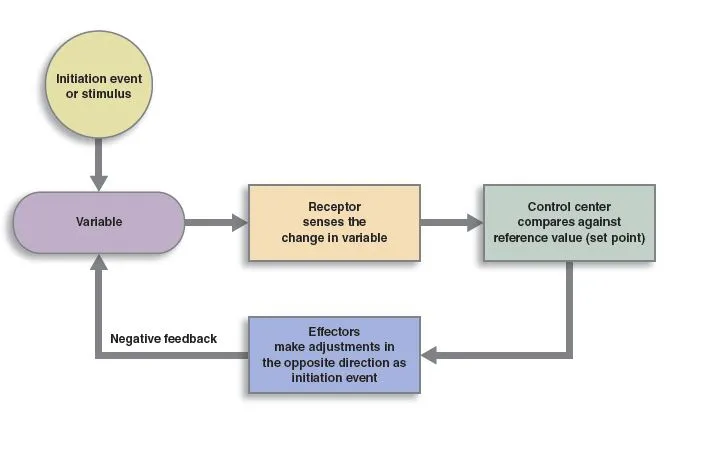 Figure: Negative feedback loop. Credit: Lumen Learning / OpenStax, CC BY 4.0.
Examples:
- Thermoregulation (cold): thermoreceptors signal the hypothalamus; it triggers vasoconstriction, shivering, and release of norepinephrine/epinephrine to raise temperature.
- Thermoregulation (hot): the hypothalamus triggers vasodilation and sweating to lower temperature.
- Blood glucose: high glucose → insulin (cells take up and store glucose); low glucose → glucagon (cells release glucose).
- Pupil diameter: dim light → dilation; bright light → constriction.
- Blood pressure: receptors monitor pressure; control centers adjust heart rate, contraction strength, and vessel diameter.
Positive feedback
A change in one direction triggers additional change in the same direction (amplification). It is inherently unstable and can cause runaway conditions, so it usually ends with a signal that shuts down the original stimulus.
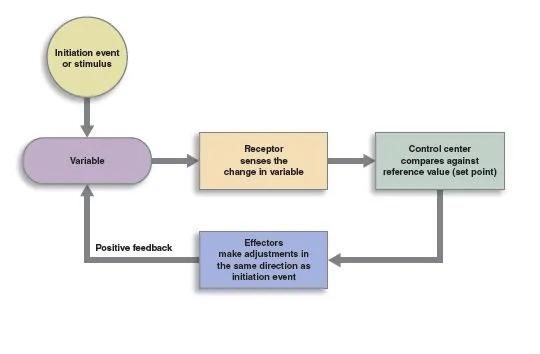 Figure: Positive feedback loop. Credit: Lumen Learning / OpenStax, CC BY 4.0.
Examples:
- Childbirth: the baby stretches the cervix → contractions strengthen → more stretching → continues until delivery, then the loop ends.
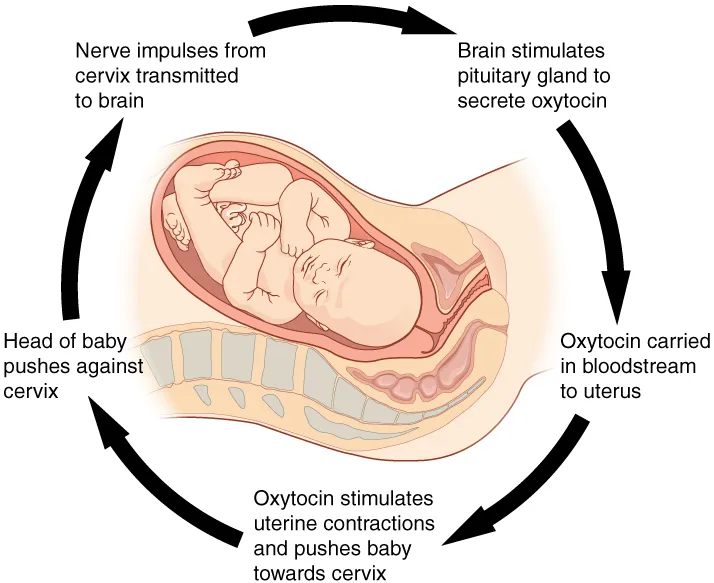 Figure: Positive feedback in childbirth. Credit: Lumen Learning / OpenStax, CC BY 4.0.
- Lactation: infant suckling stimulates prolactin release → more milk; weaning ends the stimulus.
- Blood clotting: thrombin activates more clotting proteins, amplifying until a fibrin clot forms.
- Harmful example: severe blood loss drops pressure → heart gets less oxygen → more damage → pressure falls further (potentially fatal without intervention).